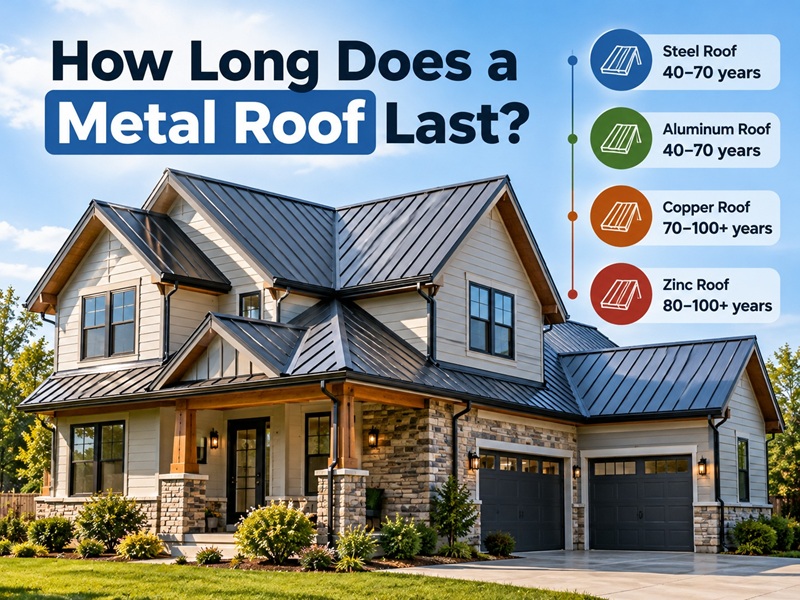
Most metal roofs are quoted at 40 to 70 years, and a few premium metals are quoted higher. But that is a range, not a promise. The metal, the paint finish, the fasteners, and the installation each age differently, and the weakest part usually sets the roof’s real life.
This guide shows what to expect by type, what tends to fail first, and why a long warranty is not the same as a long-lived roof. For the full cost comparison, see our roof lifespan guide for all materials and the links in the cost section below.
Quick answer: how long metal roofs last
Most metal roofs last about 40 to 70 years. Aluminum and standing seam systems are often quoted at the long end, while coated steel and exposed-fastener panels sit lower. Climate, finish, installation quality, and maintenance can move a roof toward either end of its range.
Metal Typical quoted lifespan What to know Steel (Galvalume or galvanized, painted) About 40–60 years in one standing seam guide; some makers quote up to 70 Depends on the coating. Scratches and cut edges are weak spots Aluminum About 50–70 years in the same guide; another guide says 40–50 Does not form red rust, so it is often chosen near salt air Copper Over 100 years in one source Premium and uncommon on homes Zinc About 80–100 years in one source Premium and uncommon on homes Sources disagree and many are manufacturers or distributors, so treat these as planning ranges. Sources are listed at the end.
Why one number can mislead
A metal roof is a system: the base metal, the factory paint, the fasteners and sealants, and the installer’s work. Each part has its own lifespan. Industry warranty guides describe three separate warranties for exactly this reason: one for the finish, one for the roof product itself, and one for the installer’s workmanship.
Lifespan by type of metal
Steel and Galvalume
Steel is the most common and usually the most affordable metal roof. Its life depends on its coating, such as Galvalume (a steel, aluminum, and zinc blend) or galvanizing, plus the paint on top. One manufacturer cites a 45–50 year steel mill warranty on Galvalume, but that is a warranty, not a forecast. Scratches, cut edges, and exposed steel are where rust usually starts. Improper field cutting can leave steel particles that damage the finish.
Aluminum
Aluminum oxidizes instead of forming red rust, which is why distributors recommend it near the coast. Even so, finish warranties can change near salt water or industrial areas, and some require extra primer or clear coat. Ask the manufacturer what your address qualifies for.
Copper and zinc
Both are quoted at many decades, but they are premium materials that need specialist installers. They are rare on typical homes.
Lifespan by roof system
| System | How it is attached | What tends to wear first |
|---|---|---|
| Standing seam | Raised seams with concealed fasteners | The finish and flashing details. One distributor says standing seam lasts longer than exposed-fastener systems |
| Exposed-fastener panels | Screws through the panel with rubber washers | Washers and sealants, often before the metal. Our lifespan guide lists 30–50 years |
| Metal shingles and stone-coated steel | Interlocking pieces | Varies by maker. Get the finish and panel warranty terms in writing |
Roof life vs warranty life
Metal roofing warranties list exclusions and often require maintenance to stay valid. Read each type separately:
| Warranty | What it usually covers | Ask |
|---|---|---|
| Finish (paint) | Film integrity, fading, and chalking. One distributor says PVDF paint warranties run 20 to 40 years for film adhesion | How much fade is allowed? Do coastal conditions change coverage? |
| Panel or substrate | Perforation from corrosion | What counts as perforation? Is it prorated? |
| Workmanship | The installer’s work, such as clips, fasteners, and trim | How long, and will the installer still exist? |
| Weathertightness (some standing seam systems) | Leaks through the system | Who issues it, and what voids it? |
A 40-year finish warranty covers the paint under stated conditions. It does not promise the whole roof lasts 40 years. Before you sign, ask in writing who issues each warranty, what is excluded, whether it transfers if you sell, and what maintenance it requires.
What fails first, and how to spot it
| Part | What goes wrong | Sign | Usual fix |
|---|---|---|---|
| Exposed-fastener screws and washers | Washers harden or crack, screws back out | Small leaks near fasteners | Replace fasteners and washers |
| Paint finish | Fading, chalking, peeling | Dull, powdery, or flaking surface | Check the finish warranty, then use a paint made for metal |
| Scratches and cut edges | Exposed steel can rust | Rust-colored spots at edges and scratches | Clean and touch up |
| Flashing and sealants | Dried or cracked sealant around chimneys, vents, and valleys | Stains below penetrations | Reseal or replace flashing |
| Dents | Hail or impact | Dents, and sometimes punctures | Judge whether it is cosmetic or functional |
Most of these are repairs, not replacements. Our guides to roof repair vs. roof replacement and the roof leak repair guide help you decide, and the roof repair cost guide covers hiring.
What shortens or extends a metal roof’s life
- Climate. Salt air, heat and UV (finish fading), and hail all stress metal roofs differently.
- Design and installation. Concealed vs exposed fasteners, finish type, panel thickness, and an installer who works with metal. One trade source calls PVDF the superior finish for durability and color retention.
- Maintenance. Check fasteners, sealants, and flashing in spring and fall and after storms. Our seasonal roof maintenance checklist shows what to look for.
Is a longer lifespan worth the price?
A simple test is cost per year: installed cost divided by expected years. Using the example figures in our new roof cost guide, a $9,000 asphalt roof lasting 25 years is about $360 per year. A $20,000 metal roof lasting 50 years is about $400 per year.
The answer is sensitive to the years you assume. If that metal roof lasts 40 years, it is $500 per year. If the asphalt roof lasts only 20, it is $450 per year. This leaves out maintenance, financing, energy savings, insurance, and resale, and it only pays off if you stay long enough to use the lifespan.
For real prices, see our guide to the cost to replace a 2,000 sq ft roof. For a full pros-and-cons view, see the pros and cons of different roofing materials and metal roof vs. asphalt shingles.
Buyer’s checklist for a long-lived metal roof
- Which metal and coating, and is it right for your climate?
- Concealed or exposed fasteners?
- Which paint finish, and what does its warranty say about fading and chalking?
- What panel thickness (gauge)? Compare it across quotes.
- Has the installer put on metal roofs before? Our guide to choosing a roofing contractor covers licenses, insurance, and red flags.
- Are all warranties in writing before you sign?
- Thinking about solar? Roof condition matters before panels go on. See our solar roofing guide.
Insurance and metal roofs
Some policies exclude cosmetic damage to metal roofs, such as hail dents that do not affect performance, so read yours before you buy. Roof age can also affect payouts through depreciation. Our guides to filing a roof insurance claim after a storm and what to do after a denied roof claim explain the process.
If you want a written inspection of an aging metal roof, you can request a roof inspection from Roofing Cop. This guide is general information and does not replace a manufacturer’s warranty terms.
FAQ Section
How long does a metal roof last?
Most are quoted at 40 to 70 years. Aluminum and standing seam systems are often quoted at the long end, and exposed-fastener panels at the short end. Finish, fasteners, climate, installation, and maintenance decide where yours lands.
Does a standing seam roof last longer?
Often yes. Concealed fasteners mean fewer rubber washers to wear out. Still, the finish, flashing, and installation matter, so compare warranty terms, not just the system type.
Does a metal roof rust?
Steel can rust at scratches, cut edges, and exposed spots. Aluminum does not form red rust. A good coating and careful installation reduce the risk for both.
Is a 50-year warranty the same as a 50-year roof?
No. Warranties cover specific things, such as paint defects or corrosion through the panel, and usually have exclusions and conditions. Read each warranty separately.
Do metal roofs dent in hail?
Large hail can dent them. Many dents are cosmetic, but check whether your insurance policy excludes cosmetic damage.
When should a metal roof be replaced?
Consider replacement when the finish is failing widely, corrosion spreads, or leaks keep returning after repairs. A written inspection helps. See our guide to the signs you need a new roof.