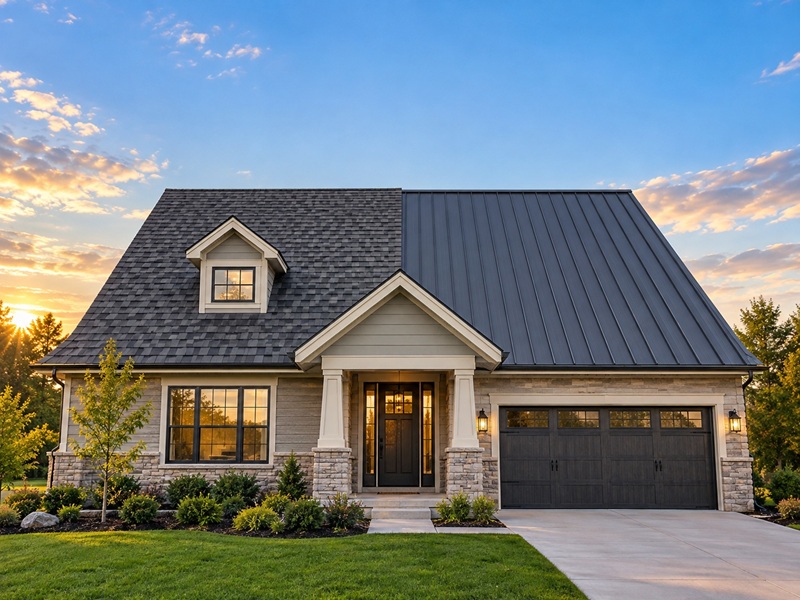
A metal roof costs about 2 to 3 times more than asphalt shingles upfront, but it lasts 2 to 3 times longer. So the better choice depends less on price and more on how long you plan to own your home.
Most roofing articles stop at “metal costs more, but lasts longer.” That is true, but it does not help you decide. A $30,000 metal roof is a bad deal if you sell in five years. A $12,000 shingle roof can become the expensive option if you stay 40 years and replace it twice.
This guide, written with the Roofing Cop team, gives you the actual numbers, the cost per year of each roof, and the situations where each one wins. It also shows where metal roofs are not worth it, which many contractor blogs skip.
Quick answer:
- Choose a metal roof if you will stay 20+ years, live in a hail, snow, or hot climate, or want the lowest maintenance.
- Choose asphalt shingles if you need the lowest upfront cost, plan to sell within 7 years, or your budget is tight.
- Typical cost for a 2,000 sq ft roof: about $8,000 to $16,000 for asphalt shingles and about $18,000 to $32,000 for a metal roof.
Quick Answer: Metal Roof vs. Asphalt Shingles at a Glance
Asphalt shingles are the cheaper roof today, and a metal roof is usually the cheaper roof over 30 or more years. The break-even point depends on your roof size, your local labor rates, and how long you stay in the house.
Here is the side-by-side comparison. These are typical US planning ranges, so your quotes will vary by region and roof complexity.
| Factor | Asphalt Shingles | Metal Roof |
|---|---|---|
| Installed cost per sq ft | $4 to $8 | $9 to $16+ |
| Total for a 2,000 sq ft roof | $8,000 to $16,000 | $18,000 to $32,000 |
| Realistic lifespan | 15 to 30 years | 40 to 70 years |
| Maintenance | Moderate (curling, granule loss, moss) | Low (check sealants and fasteners) |
| Energy efficiency | Fair | Good with reflective finishes |
| Resale value effect | Neutral to modest | Often higher, depends on your market |
| Best for | Tight budgets, shorter ownership | Long-term ownership, harsh weather |
Who Should Choose Which?
- Pick asphalt shingles if you plan to sell within 5 to 7 years, you need a roof now on a limited budget, or your HOA restricts roofing materials. You keep cash available and avoid paying for lifespan you will not use.
- Pick a metal roof if this is your long-term home, your area gets heavy snow, hail, or wildfire risk, or you plan to add solar panels. A longer-lasting roof means you avoid removing and reinstalling panels during a mid-life reroof.
- Run the numbers first if you will stay 7 to 20 years. Get three written quotes, check your insurance discount options, and compare cost per year before you decide.
Expert Tip from the Roofing Cop team: Do not compare two quotes by the final price alone. Ask each roofer to list tear-off, underlayment, flashing, ventilation, and deck repair as separate line items. A cheap quote often leaves these out, and they show up later as “extra” charges. For a metal roof, also ask which fasteners they use and how they handle thermal expansion. Most metal roof problems come from poor installation, not the metal itself.
If your roof is only partly damaged, read our guide on roof repair vs. roof replacement before you commit to a full reroof. After a storm, see how to choose a roofing contractor after a storm so you do not sign with the first door-knocker.
What Are Metal Roofs and Asphalt Shingles?
An asphalt shingle roof is made of fiberglass mats coated in asphalt and mineral granules, while a metal roof is made of steel, aluminum, copper, or zinc panels. Asphalt shingles cover most US homes because they are cheap and easy to install. A metal roof costs more but is built to last decades longer.
Knowing the types inside each category matters, because a cheap metal roof and a premium one behave very differently.
What Is an Asphalt Shingle Roof?
Asphalt shingle roof: A roof covered with fiberglass mats coated in asphalt and topped with mineral granules. It is the most common residential roofing material in the US. Depending on shingle type and climate, it typically lasts 15 to 30 years.
There are two main types of asphalt shingles:
| 3-Tab Shingles | Architectural (Dimensional) Shingles | |
|---|---|---|
| Look | Flat, uniform rows | Thicker, layered, textured |
| Typical lifespan | 15 to 20 years | 20 to 30 years |
| Cost | Lowest | About 10% to 30% more |
| Wind resistance | Basic | Better, many rated for higher winds |
| Best for | Tight budgets, rentals, short-term homes | Most homeowners |
Real example: Two neighbors on the same street both buy shingles. One picks 3-tab to save $1,500. Around year 17, his roof is curling and losing granules. The other picked architectural shingles and is still fine at year 22. The cheaper roof was not cheaper per year.
Most roofers now recommend architectural shingles, since the extra upfront cost is small compared with the extra years.
What Is a Metal Roof?
Metal roof: A roof made from steel, aluminum, copper, or zinc panels or shingles. Properly installed, it typically lasts 40 to 70 years and costs roughly 2 to 3 times more upfront than asphalt shingles.
A metal roof comes in three common styles:
- Standing seam: Long vertical panels with hidden fasteners. It is the premium choice and the most leak-resistant, and it costs the most, roughly $12 to $16+ per sq ft installed.
- Corrugated or exposed fastener (R-panel): Ribbed panels held down with visible screws. It is the cheapest metal option, around $7 to $12 per sq ft. The rubber washers on the screws wear out, so expect to re-tighten or replace screws every 10 to 15 years, and the roof often lasts closer to 20 to 40 years.
- Metal shingles or tiles: Stamped panels that look like slate, shake, or clay tile. They suit HOAs and traditional homes, and cost about $10 to $18 per sq ft.
Why this matters: Many articles quote “50 years” for all metal roofs. That number mostly applies to standing seam. If you get a low metal quote, check whether it is an exposed fastener system.
Metal Roof Materials Explained
The metal itself changes cost, lifespan, and where the roof works best.
| Material | Typical Lifespan | Cost Level | Best For |
|---|---|---|---|
| Galvanized or Galvalume steel | 40 to 70 years | Lowest metal option | Most homes, best value |
| Aluminum | 40 to 70 years | Medium | Coastal areas (resists salt corrosion) |
| Zinc | 80 to 100 years | High | Long-term or architectural homes |
| Copper | 60 to 100+ years | Highest | Luxury homes, accents, historic looks |
Two things to check on any steel quote:
- The coating: Ask if the paint is Kynar/PVDF. It holds color much longer than standard polyester paint.
- The gauge (thickness): Thinner steel dents more easily. Ask what gauge is quoted and compare it across bidders.
If you want to see how these two roofs stack up against options like slate, tile, or composite, our guide to the best roofing materials for residential homes is a good next read.
How Much Does Each Roof Cost? (Upfront Price Breakdown)
For an average 2,000 sq ft roof, asphalt shingles cost about $8,000 to $16,000 installed, and a metal roof costs about $18,000 to $32,000. Standing seam metal sits at the top of that range, while exposed fastener panels sit at the bottom.
Roofers often quote by the “square,” which is 100 sq ft of roof. So $400 to $800 per square for asphalt and $900 to $1,600+ per square for metal.
Asphalt Shingle Roof Cost
- 3-tab shingles: about $4 to $6 per sq ft installed
- Architectural shingles: about $5 to $8 per sq ft installed
- Premium or impact-resistant shingles: about $7 to $10 per sq ft installed
Most homeowners land in the middle. The price includes materials, labor, underlayment, and basic tear-off of one old layer.
Metal Roof Cost by Type
| Metal Roof Type | Installed Cost per Sq Ft | Total for 2,000 Sq Ft |
|---|---|---|
| Exposed fastener (R-panel) | $7 to $12 | $14,000 to $24,000 |
| Metal shingles or tiles | $10 to $18 | $20,000 to $36,000 |
| Standing seam steel | $12 to $16+ | $24,000 to $32,000+ |
| Aluminum, zinc, or copper | $15 to $30+ | $30,000 to $60,000+ |
Planning ranges only. Check current data from HomeGuide, Angi, or local quotes before publishing.
What Changes the Price?
- Roof size and pitch: Steep roofs are slower and riskier to work on, so labor goes up.
- Complexity: Valleys, dormers, chimneys, and skylights all add flashing work.
- Region: Labor rates in big cities and coastal areas run higher.
- Tear-off: Removing old layers costs extra, and a second layer of shingles costs more to remove.
- Deck repair: Rotten plywood must be replaced before any new roof goes on.
- Season and demand: Prices often rise after big storms because contractors get busy.
Hidden Costs Most Homeowners Forget
| Item | Why it matters | Typical extra cost |
|---|---|---|
| Deck repair | Rotten wood cannot hold a new roof | $70 to $100+ per sheet of plywood |
| Ventilation upgrade | Poor airflow shortens shingle life | $300 to $1,500 |
| Flashing and chimney work | A common leak point on both roof types | $300 to $1,000+ |
| Permit and disposal | Often left out of low quotes | $150 to $700 |
| Solar panel removal and reinstall | Needed if you already have panels | $3,000 to $6,000+ |
If you are also comparing newer products, our metal roofing vs. composite shingles breakdown shows how a metal roof stacks up against composite options.
How Long Does Each Roof Really Last?
Asphalt shingles last about 15 to 30 years, and a metal roof lasts about 40 to 70 years. The warranty number on the box is usually higher than the real lifespan, so plan with the realistic range.
Asphalt Shingle Lifespan
| Shingle Type | Realistic Lifespan |
|---|---|
| 3-tab | 15 to 20 years |
| Architectural | 20 to 30 years |
| Premium or luxury | 25 to 35 years |
Climate changes these numbers a lot. In hot southern states, heat and UV wear down granules faster, so many roofs need replacement closer to 15 to 20 years. In mild northern climates, shingles often reach the top of the range.
What shortens shingle life:
- Poor attic ventilation, which cooks the shingles from below
- Heavy shade with moss and algae
- Hail and high winds
- Cheap installation with too few nails or wrong nail placement
Metal Roof Lifespan
| Metal Roof Type | Realistic Lifespan |
|---|---|
| Exposed fastener steel | 20 to 40 years |
| Standing seam steel | 40 to 70 years |
| Aluminum | 40 to 70 years |
| Zinc | 80 to 100 years |
| Copper | 60 to 100+ years |
What shortens metal roof life:
- Poor installation, such as wrong fasteners or no room for thermal expansion
- Salt air without a corrosion-resistant finish
- Cheap paint that fades and chalks
- Scratches left unrepaired, which lead to rust
Why the Warranty Number Is Not the Lifespan
A “lifetime” or “50-year” warranty sounds great, but read the fine print:
- Material warranty: Covers manufacturing defects, often with prorated payouts.
- Paint or finish warranty: Usually 30 to 40 years for premium coatings, and covers fading or peeling limits only.
- Workmanship warranty: Comes from the installer, and it is the one that covers leaks from bad installation. Ask for it in writing and check how long the company has been in business.
A warranty from a company that closes in five years is worth very little.
Lifetime Cost Comparison: The 30-, 50-, and 70-Year Math
Over 30 years, asphalt shingles are usually cheaper. Over 50 years or more, a metal roof usually wins because you avoid buying a second or third asphalt roof.
Here is a simple example using today’s prices with no inflation. Assume a $12,000 architectural shingle roof lasting 22 years, and a $30,000 standing seam steel roof lasting 50 years or more.
| Time Window | Asphalt Roofs Needed | Asphalt Total | Metal Total |
|---|---|---|---|
| 30 years | 2 roofs (year 0, year 22) | $24,000 | $30,000 |
| 50 years | 3 roofs (year 0, 22, 44) | $36,000 | $30,000 |
| 70 years | 4 roofs (year 0, 22, 44, 66) | $48,000 | $30,000 |
What this shows: In this example, metal catches up around year 44, when the third asphalt roof is needed. In real life, it can happen sooner because shingle prices rise with inflation, and because a metal roof may raise resale value or lower your insurance bill in some areas.
Cost Per Year of Service
Use this formula with your own quotes:
Total installed cost ÷ realistic years of service = cost per year
| Asphalt (architectural) | Metal (standing seam) | |
|---|---|---|
| Example installed cost | $12,000 | $30,000 |
| Realistic lifespan | 22 years | 50 years |
| Cost per year | about $545 | about $600 |
The yearly cost is close, but metal asks you to pay it all at once. That is why cash flow and ownership time matter as much as the price.
The “How Long Will You Stay?” Decision Matrix
| You plan to stay | Better fit | Why |
|---|---|---|
| Under 7 years | Asphalt | You will not use up metal’s lifespan, and the resale bump varies by market |
| 7 to 20 years | Depends | Compare quotes, insurance discounts, and local resale data |
| 20+ years or forever home | Metal (often) | You avoid 1 to 2 asphalt replacements |
Be careful with resale promises. A metal roof helps in some markets and adds little in others, so do not count on getting the full cost back when you sell.
Metal vs. Asphalt: Head-to-Head Comparison
Metal beats asphalt on lifespan, fire resistance, and snow shedding. Asphalt wins on upfront cost, repair flexibility, and easy installation.
Durability: Wind, Hail, Fire, and Snow
| Factor | Asphalt Shingles | Metal Roof |
|---|---|---|
| Wind | Many architectural shingles are rated for 110 to 130 mph when installed correctly | Many systems are rated for 140 mph or more |
| Hail | Can crack or lose granules | Rarely leaks, but large hail can dent the surface |
| Fire | Usually Class A with the right assembly | Non-combustible, typically Class A |
| Snow | Holds snow longer | Sheds snow faster (add snow guards where needed) |
Always check the actual product rating and test standard, such as UL 2218 for impact resistance, instead of trusting general claims.
Maintenance and Repair
- Asphalt: Needs occasional checks for missing or curling shingles, moss, and clogged gutters. Repairs are cheap, and almost any roofer can do them.
- Metal: Needs a yearly look at sealants, fasteners, and flashing. Repairs are less frequent, but finding a skilled metal roofer can take more effort.
Energy Efficiency
A reflective metal roof can reduce heat gain in summer. Some studies and industry groups report cooling savings in the range of 10% to 25% in hot climates, but results depend on your attic insulation, color, and local weather. Look for ENERGY STAR or cool roof rated products if this matters to you.
Noise: Myth vs. Reality
Metal roofs are not loud when installed over solid decking with underlayment and attic insulation. In many homes, the rain sounds about the same as on shingles. Exposed fastener roofs on open-frame buildings like barns are noisier, and that is where the myth comes from.
Appearance and Curb Appeal
Asphalt shingles come in many colors, and most buyers are used to them. Metal now comes in many finishes, including styles that mimic slate or wood shake. Standing seam gives a clean modern look, and it can look out of place in some older neighborhoods.
Weight and Installing Over an Old Roof
Metal is often lighter than asphalt shingles, so it puts less load on the structure. Some codes allow metal over one layer of shingles, but a full tear-off lets the roofer check the deck for rot.
Environmental Impact
Old asphalt shingles mostly end up in landfills. Steel and aluminum roofing often contain recycled content and can be recycled again at the end of life. If sustainability matters to you, metal has the edge.
Does a Metal Roof Increase Home Value?
Yes, a metal roof often adds resale value, but it rarely returns its full cost. The size of the bump depends heavily on your local market and buyers.
What the Data Says
Roofing cost vs. value surveys, such as the Remodeling Cost vs. Value report, usually show that homeowners recover a portion of a roof project’s cost at sale, often in the range of half to two-thirds. Metal typically costs more, so the dollar gain can be bigger, but the percentage return is not always higher than asphalt. Check the latest report for your region before quoting a number.
When Metal Helps Resale
- Areas with hail, wildfire, or heavy snow, where buyers value durability
- Homes with a modern or farmhouse look where standing seam fits the style
- Buyers who want lower maintenance and possibly lower insurance costs
When It Does Not Help Much
- Neighborhoods where nearly every home has shingles and buyers do not care
- Short ownership periods, where you do not enjoy the extra lifespan
- Cheap exposed fastener systems on a home where buyers expect a premium finish
Tip: Keep the warranty papers and the installer’s details. A transferable warranty is a real selling point.
Insurance, Climate & Local Conditions: Which Roof Fits Your Area?
The best roof depends on your local risk. A roof that is perfect in a snowy state can be a poor fit in a coastal or extreme-heat area.
Insurance Premiums and Discounts
- Some insurers offer discounts for impact-resistant (Class 4) roofs, mostly in hail or storm-prone states.
- Some policies exclude cosmetic damage, such as dents, on metal roofs. Ask before you buy.
- Rules vary by state and by company, so call your insurer with the exact product name and rating.
After a storm, an insurance claim can decide which roof you can afford. Read how to pick a roofing contractor after a storm before you sign anything.
Climate Guide
| Climate or Risk | Better Choice | Notes |
|---|---|---|
| Heavy snow | Metal | Sheds snow, but add snow guards |
| Large hail | Impact-resistant shingles or thick-gauge metal | Ask about Class 4 rating and cosmetic damage coverage |
| Hot climate | Metal with cool finish | Asphalt loses granules faster in heat |
| Coastal or salt air | Aluminum or coated metal | Standard steel can corrode |
| Wildfire zone | Metal or Class A assemblies | Check local fire codes |
| Hurricane wind zone | Metal or high-wind shingles | Installation quality is critical |
Check HOA Rules and Building Codes
Before you order anything, confirm:
- Whether your HOA allows metal and which colors or profiles are approved
- Local building codes for roof over roof and wind ratings
- Permit needs and inspection steps
Metal Roof Pros and Cons vs. Asphalt Pros and Cons
Not sure which roof fits you? Use this table for a fast comparison. If you are also considering other options, our list of the best roofing materials for residential homes covers more choices.
| Metal Roof | Asphalt Shingles | |
|---|---|---|
| Pros | Lasts 40 to 70 years | Lowest upfront cost |
| Low maintenance | Fast, easy installation | |
| Strong in snow, wind, and wildfire zones | Many colors and styles | |
| Reflects heat, which can lower cooling costs | Any roofer can repair them | |
| May raise resale value in some markets | Widely accepted by HOAs | |
| Cons | Higher upfront cost | Shorter lifespan (15 to 30 years) |
| Needs a skilled installer | Loses granules and can curl with age | |
| Can dent from large hail | Struggles in extreme heat | |
| Some insurers exclude cosmetic dents | May need 2 to 3 replacements over 50 years |
Key takeaway: Metal wins on long-term value. Asphalt wins on upfront price and flexibility.
When a Metal Roof Is NOT Worth It
- You plan to sell within 5 to 7 years in a market that does not reward metal
- Your budget forces you to choose the cheapest exposed fastener system with weak installers
- Your HOA or local rules restrict metal
- Your roof is small and simple, so the cost gap does not pay back in your time frame
How to Choose Between Metal and Asphalt (Step-by-Step Checklist)
Choose by answering six questions about time, budget, weather, and rules. Then compare three written quotes.
6 Questions to Ask Yourself
- How many years will I stay in this home?
- Can I pay the higher upfront cost without stress or high-interest debt?
- What weather risk does my area face most (hail, snow, heat, wind, salt air)?
- Does my insurer offer a discount, and does it exclude cosmetic damage?
- Do my HOA and local codes allow metal?
- Do I plan to add solar panels in the next 10 years?
How to Get 3 Comparable Quotes
- Ask every roofer to quote the same material type and profile.
- Ask for line items: tear-off, underlayment, flashing, ventilation, deck repair, permit, and disposal.
- Ask for the workmanship warranty in writing and its length.
- Confirm license, insurance, and local references.
- If your roof only has minor damage, compare the cost of fixing vs. replacing first. See roof repair vs. roof replacement.
Red Flags When Hiring a Roofer
- Door-to-door offers right after a storm with pressure to sign today
- Large cash deposits before any material is ordered
- No written contract or vague scope
- Refusal to show license and insurance
- A metal quote that is far cheaper than others, with no details on fasteners or panel type
Frequently Asked Questions
How much more does a metal roof cost than asphalt shingles?
A metal roof usually costs 2 to 3 times more than asphalt shingles upfront. For a 2,000 sq ft roof, expect about $8,000 to $16,000 for asphalt and $18,000 to $32,000 for metal. Roof complexity, local labor rates, and metal type change the final price.
Which lasts longer, a metal roof or asphalt shingles?
A metal roof lasts longer. Metal typically lasts 40 to 70 years with proper installation, while asphalt shingles last 15 to 30 years depending on shingle type and climate. Hot weather, poor ventilation, and bad installation can shorten the life of either roof.
Is a metal roof worth the extra money?
It is worth it if you plan to stay in your home 20 years or more. You avoid one or two asphalt replacements and get lower maintenance. If you may sell within 5 to 7 years, asphalt shingles are usually the smarter financial choice.
Can you install a metal roof over existing asphalt shingles?
Often yes, if local building codes allow it and the existing deck is in good shape. Installers add underlayment or furring strips first. However, a full tear-off lets the roofer inspect the deck for rot, so many contractors recommend it for older roofs.
Final Verdict: Which Roof Should You Choose?
For most homeowners who plan to stay 20 years or more, a metal roof is the better long-term value. For tight budgets or shorter stays, asphalt shingles are the smarter pick.
- Forever home, harsh weather: Go with standing seam metal and a strong installer.
- Selling in 5 to 7 years: Choose architectural asphalt shingles and keep your cash.
- Middle timeline (7 to 20 years): Compare cost per year using real quotes, then check insurance and resale in your area.
- Storm damage or unsure about repair: Get an inspection first before choosing a material.
Whichever roof you pick, the installer matters as much as the material. Need a local quote or a second opinion? The team at Roofing Cop can help you compare both roof types for your home.
Disclosure: This article is for general information and does not replace an on-site inspection or a written quote from a licensed roofer.