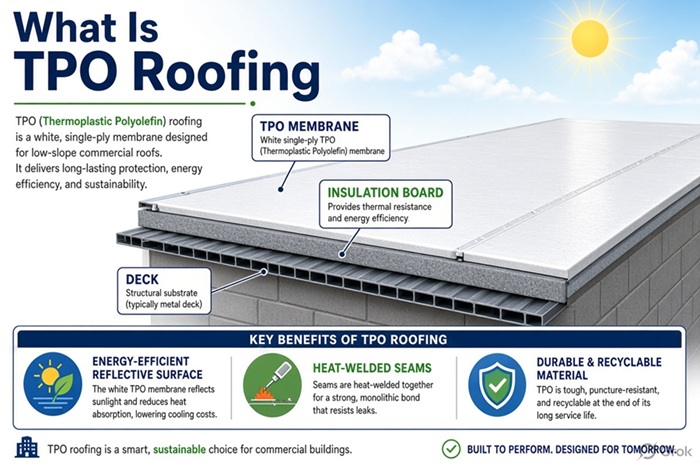
TPO roofing is a single-ply flat roof membrane made from thermoplastic polyolefin and reinforced with polyester fabric. It’s installed in large white sheets, and installers heat-weld the seams into one continuous waterproof layer. A TPO roof is used mostly on flat and low-slope commercial buildings, and it’s one of the most common choices in the US.
This guide explains what TPO roofing material is made of, how TPO roofing installation works, what it costs, how long it lasts, and what to check before you hire a crew.
What Is TPO Roofing?
TPO roofing is a flat roof system built from a thermoplastic polyolefin membrane, a flexible plastic-based sheet that is reinforced with a polyester scrim. TPO membranes must meet the ASTM D6878 specification, which sets requirements for things like thickness over scrim, breaking strength, ozone resistance, and weather resistance.
A few quick facts:
| Fact | Detail |
|---|---|
| Stands for | Thermoplastic polyolefin |
| Type | Single-ply roofing membrane |
| Best for | Flat and low-slope roofs |
| Standard | ASTM D6878 |
| Seams | Heat-welded |
| Typical color | White or light, reflective |
TPO was introduced in the 1980s and was standardized in 2003, when ASTM D6878 was first published. That makes it newer than PVC or EPDM, which is part of why its track record has some history worth knowing (see the pros and cons below).
What “low-slope” means: Flat and low-slope roofs have a minimum pitch of about 1/4 inch per foot (a 2 percent grade), designed to shed water toward drains, scuppers, or gutters. A TPO roof is not designed for steep roofs.
What Is TPO Roofing Material Made Of?
TPO roofing material is a layered sheet: a thermoplastic polyolefin top layer, a polyester fabric scrim in the middle, and another TPO layer below. The scrim gives the sheet its strength, and the top layer protects it from sun and weather.
Because TPO is a thermoplastic, it softens with heat. That allows installers to weld the seams, which gives the laps superior strength and longevity.
TPO thickness
TPO sheets come in different thicknesses, measured in mils (one mil is a thousandth of an inch).
| Thickness | What to know |
|---|---|
| 45 mil | Offered by manufacturers such as IKO in 45, 60, and 80 mil. The thinnest common option |
| 50 to 70 mil | Offered by some manufacturers as in-between options |
| 60 mil | The common middle choice |
| 80 mil | The thickest option, with a thicker top layer over the scrim |
Under the standard, 45-mil sheets need at least 15 mils of top coating over the scrim, while 60-mil sheets need at least 18 mils.
What this means for you: Thicker is not automatically better. A premium 80-mil membrane installed badly will underperform a standard 60-mil membrane installed by an experienced, manufacturer-certified crew. Ask what’s under the top layer, not just the mil number.
Pros and Cons of a TPO Roof
A TPO roof is popular because it is reflective, welds into a seamless surface, and costs less than PVC. Its main downsides are a lifespan on the shorter side and quality that varies between manufacturers and installers.
| Pros | Cons |
|---|---|
| Energy-efficient “cool roof” that can keep a roof about 50 degrees cooler than conventional materials | Often lasts a shorter time than PVC, roughly 15 to 20 years in some estimates |
| Heat-welded seams create a continuous membrane | TPO only bonds to itself, so flashings often use TPO-clad metal |
| Costs less than PVC with similar thermal performance | Performance depends heavily on installer skill |
| Easy to repair because it heat-welds quickly | Early products had heat-aging problems (see below) tpo roofing +4 |
What you should know about the early failures: Studies of in-service roofs found that heat, not UV, caused much of the earlier failures in TPO products. The standard has since tightened. Heat aging requirements were added in 2011, and a requirement on retained properties after heat aging was added in 2017. If you’re buying today, ask for a membrane tested to the current ASTM D6878 edition, with a documented heat-aging package.
TPO Roofing Installation: How It Works
TPO roofing installation means preparing the deck, adding insulation, rolling out the membrane, attaching it, and heat-welding every seam. Before the membrane goes down, the installer adds insulation, and at least half an inch of insulation board is generally used.
The three main installation systems
| System | How it works | Trade-offs |
|---|---|---|
| Mechanically attached | Membrane is fastened to the deck | The most common and cost-effective method for large commercial roofs |
| Fully adhered | Membrane is glued to the substrate | Better wind performance and a flatter look, at higher labor cost |
| Ballasted | Weight (stone) holds the membrane down | Lower labor cost, but adds dead load to the structure and needs structural verification |
| Induction-welded | Plates are welded through the membrane | Efficient for large roofs and can reduce labor costs TPO Roofing Guide: Cost, Install, Lifespan, & Energy Benefits +3 |
Step by step
- Inspect the deck. Find and fix soft spots, rot, and moisture before anything goes on.
- Tear off or prepare the old roof. Remove it, or prepare it if the system allows a recover.
- Install insulation. Boards go over the deck, often tapered so water flows toward drains.
- Roll out the TPO membrane. Sheets are laid with overlaps.
- Attach the membrane. Using one of the systems above.
- Weld the seams. Hot-air welding fuses the overlaps.
- Flash the edges and penetrations. Around vents, drains, curbs, and walls.
- Inspect and document. Check every seam, then file the manufacturer’s warranty paperwork.
Installation mistakes to watch for
- Poor seam welds that leave small gaps
- Sharp creases in the membrane
- Ponding water from poor slope or missing tapered insulation
- Uncertified crews that void the manufacturer’s warranty
A real-world example: In an IIBEC review of field-aged TPO roofs, hot-air-welded seams generally held up well, and one roof’s cracking was tied to a sharp crease made during the original installation. The material was fine. The install wasn’t.
DIY? TPO installation is a large project that calls for an experienced roofer to be done safely and correctly. Leave it to a certified crew.
If your flat roof has parapet walls, the cap along the top matters too. A failing roofing cop lets water in behind the membrane no matter how good the TPO is.
How Much Does a TPO Roof Cost?
Most sources put TPO roofing at roughly $4 to $12 per square foot installed, with wider ranges up to about $16 on complex jobs. Estimates vary a lot, so use these as a starting point and get local quotes.
- One estimate puts installed TPO at $4.50 to $16 per square foot, depending on thickness and complexity.
- Another puts it at $5 to $12 per square foot, depending on thickness, system type, and whether tear-off is needed.
- For a 1,500-square-foot roof, one source estimates roughly $6,800 to $21,000.
| Cost driver | What it does to your price |
|---|---|
| Membrane thickness | Thicker sheets cost more |
| Attachment system | Fully adhered costs more in labor than mechanically attached |
| Insulation | Upgrades can add $0.50 to $3.00 per square foot |
| Tear-off | Removing an existing roof can add $1 to $2 per square foot |
| Roof complexity | Multiple levels and penetrations raise installation cost |
| Local labor | Varies by region financing your tpo roofing installation +2 |
How to compare quotes: Ask each contractor for thickness (in mils), attachment method, insulation R-value, flashing details, and warranty terms, all in writing. A lower price often means a thinner membrane or less insulation.
How Long Does a TPO Roof Last?
A TPO roof typically lasts 15 to 30 years, depending on installation quality and maintenance. One roofing source gives that range and notes that poor installation shortens it while expert installation gives the roof the best chance at a long life.
| What affects TPO lifespan | Why it matters |
|---|---|
| Membrane thickness | Lifespan depends more on thickness than on membrane type |
| Installation quality | Seam welds and flashing are the usual weak points |
| Heat and sun exposure | Heat has been the leading stress on TPO |
| Maintenance | Debris, ponding water, and ignored damage shorten life |
Want to compare TPO to other flat roofs and every roof material? See our guide on how long a roof lasts.
Maintenance tips:
- Clear debris with a soft-bristled broom and mild detergent.
- Inspect seams and flashing each spring and fall. Our seasonal roof maintenance checklist covers what to check.
- Keep drains and scuppers open.
- For heavy buildup, professional roof cleaning is safer than doing it yourself.
- After hail or wind, learn how a roof insurance claim after a storm works before paying for repairs yourself.
- If you see widespread cracking or failing seams, read the signs you need roof replacement.
TPO vs. EPDM vs. PVC
TPO and PVC both use heat-welded seams, while EPDM uses glued or taped seams. Price and lifespan differ, so match the membrane to your building.
| Feature | TPO | EPDM | PVC |
|---|---|---|---|
| Seams | Heat-welded | Glued or taped, since it’s a thermoset | Heat-welded |
| Thickness | 45 to 80 mil and up | 45 to 90 mil | Varies by manufacturer |
| Cost | Lower than PVC | Often lowest | Typically higher than TPO |
| Track record | Since the 1980s | Long | Since the 1960s |
| Typical color | White, reflective | Usually black | White or light Building Science +6 |
Across single-ply membrane types, lifespan and warranty coverage are often comparable, and thickness matters more than type. That’s the honest answer: the best membrane is the one installed well.
Is TPO Roofing Right for You?
TPO is a good fit for flat or low-slope roofs where you want a reflective, cost-effective membrane with seam repairs that are easy. It’s a poor fit for steep roofs.
It’s a good choice if you have:
- A warehouse, retail building, school, or office with a flat roof
- A flat residential roof or addition
- A hot climate where reflectivity cuts cooling costs
- A budget that rules out PVC
Think twice if:
- Your roof has a steep pitch
- You expect heavy foot traffic or rooftop equipment
- You can’t find a manufacturer-certified installer
- You want the longest possible membrane life
FAQs
What is TPO roofing?
TPO roofing is a single-ply flat roof membrane made from thermoplastic polyolefin and reinforced with polyester fabric. Installers heat-weld the seams to create one continuous waterproof layer. It’s used mainly on flat and low-slope commercial roofs and is known for being reflective and cost-effective.
What is TPO roofing material made of?
TPO roofing material is a sheet made from thermoplastic polyolefin, with a polyester scrim sandwiched inside for strength. It’s usually white to reflect heat. It comes in thicknesses such as 45, 60, and 80 mil, and should meet the ASTM D6878 standard.
How long does a TPO roof last?
A TPO roof typically lasts 15 to 30 years. Quality of installation, membrane thickness, heat exposure, and maintenance all affect where it falls. Well-welded seams and regular inspections help it reach the longer end of the range.
How much does TPO roofing installation cost?
TPO roofing installation typically costs about $4 to $12 per square foot, with some estimates running higher on complex jobs. Thickness, insulation, tear-off, roof complexity, and local labor rates all change the price. Get several written quotes to compare.
Is a TPO roof good for homes?
A TPO roof works well on flat or low-slope residential roofs, such as additions, porches, and modern flat-roof homes. It isn’t designed for steep roofs, where shingles or metal are better choices. Use a certified installer and confirm local code requirements.
Planning a Flat Roof? Start With an Inspection
Not sure if TPO is right for your building? Our team can inspect your roof, check the deck and drainage, and explain your options in plain language.
1 thought on “What Is TPO Roofing? Material, Cost, Lifespan and Installation (2026 Guide)”