
An actual cash value roof clause is what decides how much of a new roof your insurer will pay for and how much comes straight out of your pocket. That difference shows up the day a storm rips shingles off and the adjuster starts talking in numbers that do not match your roofer’s estimate.
We are going to walk through how ACV and replacement cost work on roofs, how a typical roof payment schedule insurance setup works, where people get surprised on depreciation, and what to check in your policy before the next storm. Along the way we will point you to pricing guides such as Roof Replacement Cost by State so you can line the numbers on paper up with what a new roof really costs where you live.
Why Your Roof Coverage Type Matters So Much
Most owners only learn the difference between ACV and replacement cost when a claim check lands thousands below the contractor’s bid and work is already scheduled. At that point you are trying to fill a gap with savings or a loan instead of picking coverage that actually fits the roof, and a quick read on New Roof Cost can be a wake up call. We wrote a separate piece on Roof Inspection Cost, and it pairs well with this step.
On an ACV policy, the insurer starts from the cost to replace the roof, then subtracts depreciation for age and wear. That is how two homes on the same street can get very different checks for similar damage, and it is why browsing Roof Replacement Cost ranges before any claim gives you a rough idea of what a full replacement really costs where you live.
Actual Cash Value vs Replacement Cost on Roofs
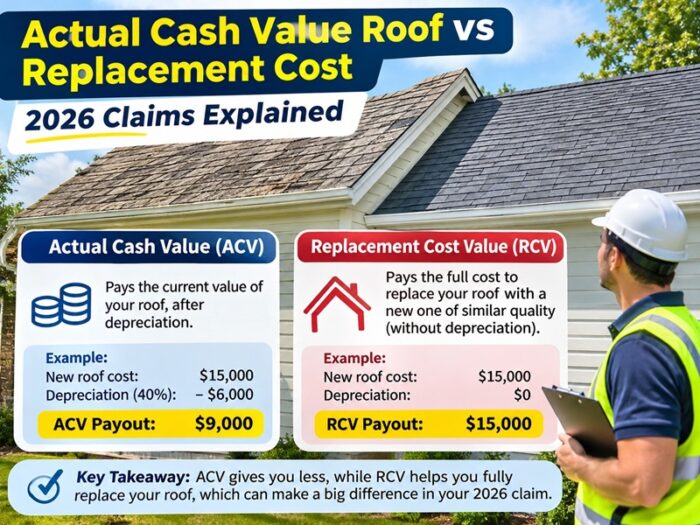
The short version of roof acv vs rcv is simple. ACV pays what the roof is worth today after the carrier applies depreciation. RCV is built to pay what it costs to put similar materials back on the house, subject to your deductible and policy limits.
Under ACV, the adjuster looks at roof age, condition and expected life, then assigns a depreciation percentage. Under RCV, the insurer still calculates depreciation, but that amount is treated as “recoverable” once you prove the work is done, so reviewing ranges such as those in It Cost to Replace a 2,000 Sq Ft Roof keeps most people from guessing too low on what a replacement runs in their state.
How Insurers Calculate Actual Cash Value
Insurers calculate ACV with their own life expectancy charts and depreciation formulas, not what your roofer thinks the roof has left. A 25 year shingle at 18 years old might be treated as most of the way through its life, so only a slice of full replacement shows up in that first check.
If your policy is written as an acv roof endorsementthat language can cap the carrier’s responsibility at the depreciated number even if you fully replace the roof. In practice, that leaves a gap between the crew’s invoice and what insurance pays, and that gap can be large on older roofs that also have separate wind or hail deductibles.
Replacement Cost on Roofs Still Has Limits
Replacement cost sounds like a blank check, but it is not. Limits, exclusions and age rules still apply, especially on older shingles or non standard systems, so you still need to read.
Some policies split the difference, with RCV on the house structure and ACV on the roof covering. When you see language comparing replacement cost vs actual cash value roof on your declarations, slow down and get clear which part applies to the shingles, sheathing and underlayment before you try to compare those terms with a guide like Roof Repair vs Roof Replacement.
How a Typical Roof Payment Schedule Works
Most carriers follow a similar structure on a storm claim, even if the labels on the paperwork differ a bit. First you get an initial ACV check after the adjuster’s inspection, then later you may get recoverable depreciation, and sometimes you see supplemental payments if legitimate items were missed on the first scope.
The sequence usually starts with an inspection, then a written estimate, then the first check. If you have never been through it before, it helps to read a walkthrough such as File a Roof Insurance Claim After a Storm (Step-by-Step) before water spots show up and you are trying to decode line items under pressure.
Step 1: Inspection and Initial Estimate
After a storm, your first moves should be to protect the home, take clear photos and get your own roofer’s opinion. Waiting for the carrier’s inspection without basic documentation is where people lose ground fast.
Once the adjuster inspects, they issue an estimate that shows full replacement cost, calculated depreciation, ACV and any line items for code upgrades or extra trades. At this point, comparing their scope against a local bid from a contractor who understands Repairing Hail Damage on a Roof often exposes missing vents, underlayment or flashing that should be in the claim before work starts.
Step 2: ACV Check and Your Deductible
The first payment is usually the ACV portion, which is full replacement minus depreciation and then minus your deductible. A lot of sticker shock comes from how those two numbers combine, especially on older roofs with percentage based wind or hail deductibles.
If the first check feels light, ask for a clear breakdown of age, depreciation rate and any line items marked as wear instead of storm damage. It is also a good time to compare the estimate with ranges in It Cost to Replace a 2,000 Sq Ft Roof so you know whether the claim math is in the right ballpark.
Step 3: Recoverable Depreciation and Final Payments
On RCV policies, recoverable depreciation gets released after the roof is installed and you or the contractor send in a final invoice and completion photos. Carriers sometimes want proof that you actually paid your deductible as well.
There can also be supplemental payments later for items missed on the first scope, like rotten decking found during tear off. Those are much easier to secure if you had a pre job inspection or report that laid out the Roof Inspection Cost and findings instead of trying to argue from a few dark attic photos.
Reading the Fine Print on Roof ACV and RCV
Policy language around roofs has tightened in many storm heavy states over the last decade. Insurers added separate deductibles, ACV endorsements and age based exclusions, and many homeowners did not notice the change until a claim exposed it.
Your declarations page and endorsements will usually state if the roof is on ACV terms, RCV terms or a mix. That same packet also spells out any deadlines for filing or disputing a decision, which you will want to understand before you end up in a situation described in Insurance Denied Your Roof Claim.
Common Policy Traps on Roof Coverage
Common traps include cosmetic damage exclusions, matching limitations on shingles and age cutoffs where a roof older than a stated number of years only qualifies for ACV. There can also be specific endorsements that exclude certain causes, like wind driven rain under a stated wind speed.
Because many of these rules hide in endorsements, not on the main coverage page, it is smart to pull the whole packet once a year and read the roof sections together with resources about hail damage roof insurance if you live in a hail belt.
Actual Cash Value Roof Coverage and Your Costs
The biggest practical difference between ACV and RCV is what you personally have to fund to get a watertight roof back over your head. On a full ACV setup, that gap can be large.
If a policy only pays ACV with no recoverable depreciation, your out of pocket is the difference between the roofer’s invoice and the ACV check plus your deductible. That is one reason so many owners who pay close attention to Roof Replacement Cost decide to change coverage at renewal if their carrier offers an upgrade from ACV to RCV.
Planning for Future Roof Claims
Planning ahead means matching your coverage type to the age and value of the roof instead of only chasing the lowest premium. A cheaper rate looks good until you see an ACV calculation on a 20 year roof that costs much more to replace than it is treated as worth on paper.
It also means budgeting for inspections, routine maintenance and cleaning so your roof lasts longer and is in better shape when the next storm hits. Spending a little on Roof Cleaning and periodic checkups every few years usually costs far less than one surprise replacement.
Conclusion
Your policy’s treatment of an actual cash value roof versus replacement cost decides who pays what on your next storm claim. Taking a couple of hours now to read your declarations, endorsements and payment schedule is less painful than trying to fix a payout after the checks are already cut. If you’d like help with this, reach out through our Contact Us page.
If you want an experienced eye on the fine print and real world pricing, reach out to Roofing Cop before renewal or before you sign off on a claim estimate so your coverage lines up with what a roof really costs in your area.
Frequently Asked Questions
Q1. What is the difference between ACV and RCV on a roof claim?
Ans. ACV pays what the roof is worth after depreciation for age and wear, while RCV is structured to cover the full replacement cost, subject to your deductible and policy limits. On RCV, part of the claim is often paid later as recoverable depreciation once the work is completed.
Q2. Why is my first roof insurance check smaller than the contractor’s estimate?
Ans. The first check usually reflects the ACV amount, which is full replacement cost minus depreciation and your deductible. The remaining amount may be paid later as recoverable depreciation if you have replacement cost coverage and submit final invoices and photos.
Q3. Can I upgrade from actual cash value to replacement cost coverage on my roof?
Ans. Many insurers offer an option to move from ACV to RCV on renewals, though availability depends on your roof’s age, condition and location. You will need to talk to your agent about underwriting rules and possible premium changes.
Q4. How does roof age affect an ACV payout?
Ans. Insurers use expected life tables to decide how much value a roof has lost based on age and type. An older roof is considered mostly depreciated, so a larger portion of the replacement cost is treated as depreciation and not included in the ACV check.
Q5. Do I have to use the insurance company’s preferred roofer?
Ans. In most cases you can choose your own licensed contractor, even if the insurer suggests preferred vendors. What matters is that the scope of work matches the covered damage and the contractor is willing to work within the claim paperwork.
Q6. What happens if the roofer finds more damage once work starts?
Ans. When hidden damage is discovered during tear off, your contractor can document it and submit a supplemental claim to the insurer. If the extra items are tied to the covered event and are reasonable, the carrier often issues an additional payment to cover them.